
As an Amazon Associate I earn from qualifying purchases. This post may contain affiliate links. Read our disclosure.
Quick answer: enter your product’s length, width and thickness below. The calculator picks the smallest standard poly mailer, bubble mailer or box that fits, then shows its dimensional weight for USPS, UPS and FedEx. Already have a box? Tick the box option to check its dimensional weight directly.
Mailer, box and dimensional weight calculator
Enter your product’s size as packed (in its polybag or retail box) to get the right mailer or box and its dimensional weight for USPS, UPS and FedEx. Any order works: the finder sorts length, width and thickness for you.
How the size finder works
We use one rule for each type of packaging and show the numbers behind every result, so you can check it yourself.
Poly and bubble mailers
A flat mailer has to wrap around the product, so thickness takes up part of its width and length. The finder adds the product’s thickness plus 1 inch of slack to each flat side:
- Mailer width needed = product width + thickness + 1 in
- Mailer length needed = product length + thickness + 1 in
It then picks the smallest common size that covers both. Mailer sizes are listed as width × length of the usable area, not counting the seal flap. Other guides use slightly different rules; Vistaprint’s packaging guide, for example, adds the product’s depth to both width and length, plus extra room for the flap. If your product is close to the limit of a size, go one size up.
Boxes
For boxes, the finder adds padding to every side of the product, then picks the smallest common box (by volume) whose inside dimensions fit:
| Product type | Padding on each side | Why |
|---|---|---|
| Soft goods | 0.25 in | Clothing compresses and needs little cushioning |
| Rigid, not fragile | 0.5 in | Room for a layer of kraft paper or air pillows |
| Fragile | 2 in | Space for cushioning that absorbs drops |
Box sizes are inside dimensions. Fill the padding space with void fill so nothing moves: see our void fill guide.
When it recommends each type
- Poly mailer: soft goods up to 3 in thick. Thicker items bulge and stretch the seams.
- Bubble mailer: rigid, non-fragile items up to 1.5 in thick, such as books, phone cases and small boxed products.
- Box: fragile items, anything thicker than those limits, and anything that must not bend.
Still deciding between packaging types? Read bubble mailers vs poly mailers vs boxes.
Standard sizes the finder uses
These are common stock sizes. Exact sizes vary by brand, so always check the inside dimensions on the listing before you buy.
Poly mailers (width × length)
| Size | Typical use |
|---|---|
| 6 × 9 in | Socks, small accessories |
| 7.5 × 10.5 in | T-shirts folded small, leggings |
| 9 × 12 in | Folded T-shirts |
| 10 × 13 in | Shirts, light sweaters |
| 12 × 15.5 in | Hoodies, jeans |
| 14.5 × 19 in | Bulky hoodies, two-item orders |
| 19 × 24 in | Jackets, bedding |
| 24 × 24 in | Large soft items, multi-item orders |
More detail in our poly mailer sizes guide.
Bubble mailers (typical inside size)
| Number | Inside size |
|---|---|
| #000 | 4 × 8 in |
| #00 | 5 × 10 in |
| #0 | 6 × 10 in |
| #1 | 7.25 × 12 in |
| #2 | 8.5 × 12 in |
| #3 | 8.5 × 14.5 in |
| #4 | 9.5 × 14.5 in |
| #5 | 10.5 × 16 in |
| #6 | 12.5 × 19 in |
| #7 | 14.25 × 20 in |
Boxes
The finder checks 36 common stock box sizes, from 6 × 4 × 4 in up to 24 × 24 × 24 in. If nothing fits, it tells you to look for a larger or custom box.
Dimensional weight: how each carrier calculates it
Dimensional weight charges a parcel for the space it takes up. The basic formula is the same everywhere: length × width × height in inches, divided by a divisor. The carrier then bills whichever is higher, dimensional weight or actual weight. The details differ by carrier, and the calculator applies each rule separately:
| Carrier | Divisor | When it applies | How sides are rounded |
|---|---|---|---|
| USPS (Priority Mail, Ground Advantage, Priority Mail Express, Parcel Select) | 139 (changed from 166 on July 12, 2026) | Only packages larger than 1 cubic foot (1,728 cubic inches) | Up to the next whole inch |
| UPS daily rates (online or account) | 139 | Any package size | Up to the next whole inch |
| UPS retail rates (UPS Store counter) | 166 | Any package size | Up to the next whole inch |
| FedEx (US) | 139 | Any package size | To the nearest whole inch |
All four round the result up to the next whole pound. So a 16 × 12 × 8 in box weighing 4 lb is billed at 4 lb with USPS (it is under 1 cubic foot), but at 12 lb with UPS daily rates and FedEx. Small changes in box size can move you across these lines, which is why the calculator shows every carrier side by side.
USPS Cubic-priced labels (common with discounted shipping software) use a separate tier system based on volume, not dimensional weight. See Ground Advantage cubic pricing and dimensional weight in 2026 for more. Always weigh the packed parcel on a shipping scale; do not guess.
Sources, checked November 2026: UPS: package dimensions and weight, FedEx: what is dimensional weight, Pirate Ship: July 2026 USPS rate and rule changes. Carriers change these rules; your negotiated rates or software may differ, so confirm with your carrier for large volumes.
Shop the sizes
Poly mailers


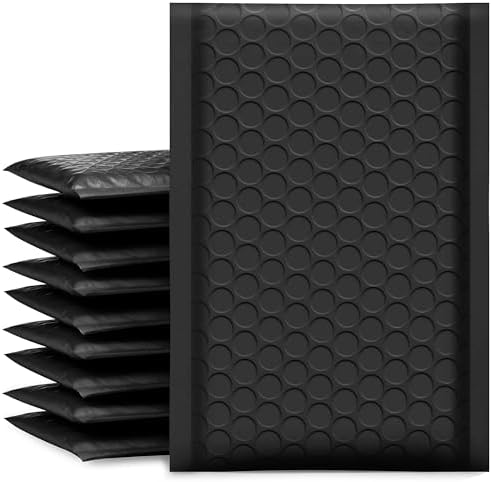
Bubble mailers


Shipping boxes


Common questions
Should I measure the product or the product in its packaging?
Measure it exactly as it goes into the mailer or box: folded, in its polybag or retail box, with any insert. That is the size that has to fit.
My product fits two sizes. Which should I pick?
Pick the smaller one if the product is soft and has room to spare. If it is a tight fit, or the item is rigid, go one size up so the seal and corners do not split.
Why does UPS show a higher weight than USPS for the same box?
USPS only applies dimensional weight above 1 cubic foot. UPS and FedEx apply it to every package, so a light box under 1 cubic foot can cost more by weight with them. Above 1 cubic foot, USPS, UPS daily rates and FedEx now all use the same 139 divisor.
Do I need a box for every fragile item?
Yes. Mailers do not stop crushing, and a drop transfers straight to the item. Use a box with about 2 inches of cushioning on every side.
Setting up your packing station from scratch? Start with the Seller Starter Kit.